The Story in Your Head Isn’t Always the Whole Story
Something happens at work. Your boss responds to every email except the one where you asked for a decision. You offer an idea in a meeting and get silence, only to hear a similar idea gain traction ten minutes later. A normally friendly colleague sends, “We need to talk. Call me when you can.”
Within seconds, you are no longer responding only to what happened. You are responding to what you think it means: They are ignoring me. I explained it badly. My voice does not matter. I am in trouble.
The story may be right. It may be partly right. It may also be one explanation your brain created before you had enough information.
How do you tell the difference without dismissing your instincts or treating your first interpretation as fact?
What Happened, and What Did You Make It Mean?
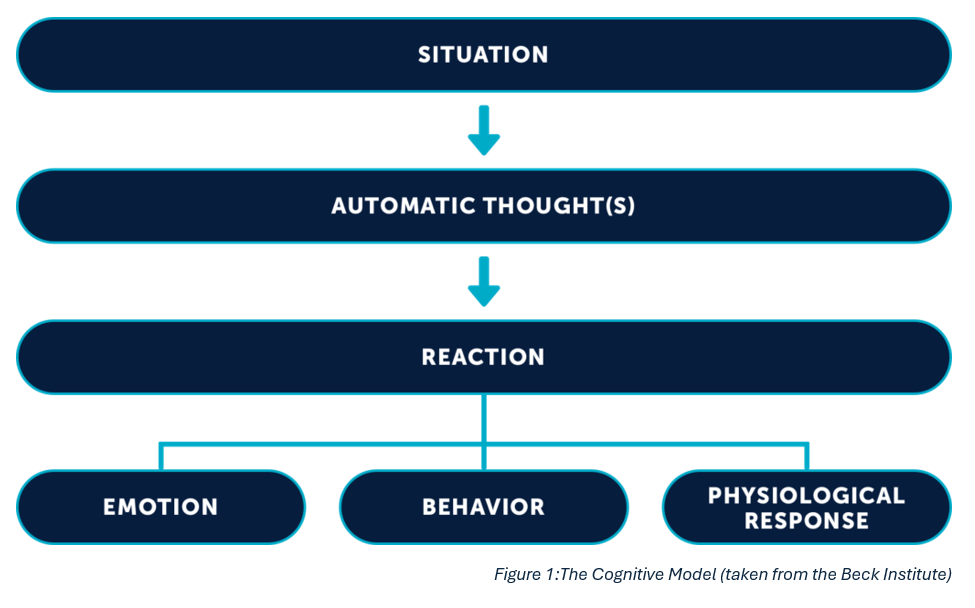
One of the ideas from cognitive behavioral approaches is also one of the simplest: The situation and our interpretation of the situation are not always the same thing. Our thoughts and perceptions help shape how we feel and respond. That relationship between situations, thoughts, emotions, and behavior is central to the cognitive model (see image above).
That does not mean the situation is imaginary, the emotion is wrong, or a negative interpretation is automatically inaccurate. It means two people can experience the same event, give it different meanings, and react very differently.
Consider the unanswered email. The observable facts might be:
- You sent your boss a question two days ago.
- They have not answered it.
- You have seen them respond to other messages.
Everything after that is interpretation. Maybe your request is not important to them. Maybe they have not made a decision. Maybe the email was too long to answer quickly. Maybe they need information you did not know to include. Maybe they are avoiding it.
Or maybe you start investigating yourself: Did I overexplain? Did I leave out the most important detail? Did they misunderstand me? Does my voice matter here?
I know that spiral. Overexplaining can be helpful when the details matter, but in the wrong time and place, it can overwhelm people. I do not mind being wrong or having an idea rejected. What is harder is feeling as though I was not understood or that my voice did not matter.
That experience influences the meaning silence can carry. But it still does not explain why the person has not answered.
Why the First Story Can Feel So Complete
Our brains do not love an information vacuum. When the reason for someone’s behavior is unclear, we try to create a coherent explanation using the information, experiences, and expectations already available to us.
Sometimes that process protects us. It helps us recognize familiar patterns, anticipate problems, and respond quickly. It can also make the first plausible explanation feel like a finished investigation.
Stress makes this harder. Research on acute stress and executive functioning found that stress generally impaired working memory and cognitive flexibility, including our ability to hold information in mind and shift between possibilities. A separate review of stress and decision-making found that the effects vary by person, timing, task, and type of decision.
The science is more nuanced than “stress makes you think badly.” Pressure can change which information we notice and use. That matters in demanding workplaces because the moments when we most need a wider view are often the moments when we have the least mental space to create one.
The stories that appear under pressure may sound familiar:
- If I do not handle this myself, it will fall apart.
- No one else cares as much as I do.
- They should already know what I need.
- One mistake means I cannot trust them.
- If I raise the issue, I will be seen as difficult.
Any one of those thoughts might contain truth. The problem is not having the thought. The problem is making a decision before checking whether it is the whole story.
Separate What You Know From What You Think
One practical question can interrupt the rush from event to conclusion:
What else could be true?
This is not positive thinking. You are not replacing “My boss does not value my work” with “My boss thinks I am amazing.” Neither statement is supported by an unanswered email.
The question simply creates more than one possible explanation. That small shift can change the next move from reacting to investigating.
To make the process concrete, separate the situation into three parts:
- What do I know? Use only what could be observed, documented, or independently confirmed. What was said? What happened? What deadline was missed? What information do you actually have?
- What do I think it means? Name the interpretation honestly. I think they ignored me. I think they do not trust me. I think I overwhelmed them. Do not shame yourself for having the thought, but do not disguise it as a fact.
- What do I need to find out? Identify the question, conversation, observation, or pattern that would help you make a better decision.
High-pressure work often requires decisions with incomplete information. You may not have time to investigate every possibility. In those moments, name the assumptions you are making, consider what happens if they are wrong, and choose a next step that leaves room to adjust. A provisional decision is different from pretending you know.
The same process can also change how you interpret people you trust. A normally warm colleague sends a short, unexpected message asking you to call. That may still create a principal’s-office feeling in your gut. But if the relationship has consistently been positive, concern may be more useful than self-blame: This is not like them. Are they okay?
The physical reaction can show up before the facts. You do not have to treat that reaction as evidence that you did something wrong.
Wellness Action: Before reacting to a difficult workplace situation, ask: What do I know? What do I think it means? What do I need to find out? Then identify the next action that would give you useful information.
Look for Patterns Without Explaining Them Away
Asking what else could be true should make your thinking more accurate. It should not become a way to talk yourself out of what you are experiencing.
Imagine offering an idea in a meeting and receiving no response. Ten minutes later, someone else offers something similar and suddenly everyone wants to discuss it. One incident may be ambiguous. When it happens repeatedly, it becomes additional information.
Does the group tend to ignore the first idea until the conversation warms up? Does everyone engage primarily with the supervisor’s suggestions? Is one person’s input consistently favored? Are women regularly interrupted, overlooked, or denied credit?
That last possibility should not be dismissed as someone taking a meeting too personally. A review of gender equity in virtual and in-person meetings describes evidence that meeting dynamics can disadvantage women and recommends structural changes rather than expecting individuals to solve the problem alone.
Patterns help distinguish a personal trigger from a team norm or organizational problem. If all first ideas receive little engagement, the group may need time to warm up. If only the supervisor’s ideas gain traction, hierarchy may be shaping the discussion. If women’s ideas are consistently dismissed, that is a larger issue to raise through the appropriate channel.
The same guardrail applies to workload and working conditions. The World Health Organization identifies excessive workloads, understaffing, limited control, inadequate support, harassment, discrimination, and unclear roles as workplace risks. It recommends interventions that change working conditions, not only individual strategies. The National Institute for Occupational Safety and Health similarly examines how work organization contributes to job stress.
If an employee raises a legitimate workload problem and is told to manage time better or think more positively, the issue may not be the story in the employee’s head. The response itself is new evidence.
“What else could be true?” is the beginning of an investigation, not a requirement to assume positive intent forever. Sometimes another explanation helps. Sometimes a repeated pattern confirms that something really does need to change.
Better Thinking Is Not Nicer Thinking
Clear thinking does not require you to assume everything is fine. It asks you to become more precise.
What happened? What did you make it mean? What else could be true? What pattern do you see? What do you need to learn, ask for, document, or change?
Sometimes that process will show that an unanswered message was not a rejection. Sometimes it will confirm that someone’s voice is repeatedly dismissed or that the workload is genuinely unreasonable.
The goal is not to talk yourself out of your experience. It is to make sure your next move is based on the fullest story available, not simply the first one your stressed brain supplied.